Socializing a Rottweiler With Kids, Dogs and Strangers
General training information. Every dog is an individual; for health or behavior concerns, see your veterinarian.
Many families ask the same thing before bringing a puppy home: are Rottweilers good with kids? The honest answer is that it depends on the dog, the household and the work you put in. The American Kennel Club (AKC) rates the breed 3 out of 5 for being good with young children, on a scale where 3 means "with supervision." It gives the same 3 out of 5 for getting along with other dogs.
That is not a warning label. It is a job description. This guide walks through a practical Rottweiler socialization plan for children, other dogs and strangers, with the supervision habits that make each step safer.
What the Breed Sources Say First
The AKC summarizes the Rottweiler as a loyal, loving and confident guardian. The AKC breed standard describes a calm, confident, courageous dog with a self-assured aloofness and an inherent desire to protect home and family. It also says the breed responds quietly with a wait-and-see attitude.
The American Rottweiler Club (ARC) adds that individual dogs range from a natural clown to a reserved one-person dog. So expect a spread. Your puppy may greet every guest like an old friend, or may hang back and watch. Both can be normal, and both need a plan.
The AKC also rates the breed 3 out of 5 for openness to strangers, which means ambivalent. Do not count on a Rottweiler to love everyone. Aim for a dog that stays calm and neutral around people it does not know.
Materials You Will Need
- Small, soft treats your dog loves, cut into tiny pieces
- A flat collar or a well-fitted harness and a standard leash
- A long line for practice in open areas
- A crate, exercise pen or baby gate so your dog has a safe place to rest
- A mat or bed to use as a "settle" spot
- A sign-up for a group class (see the first step below)
- A helper or two who can follow instructions calmly
Skip shock, prong and choke collars. The ARC's trainer guide lists prong, choke and electronic collars as tools you do not want to see in a class. They also work against the calm, trusting relationship you are building.
Step-by-Step Rottweiler Socialization Plan
1. Enroll in a puppy class with a positive-reinforcement trainer
The ARC says obedience training is a must. It recommends a group class with an experienced trainer who uses positive reinforcement, and it points to Puppy Kindergarten for socialization. Ask to watch a class before you sign up. Look for relaxed dogs, rewards for good choices and no rough handling.
The ARC also notes that sensitive, positive methods, time and patience matter more than physical mastery. For the full foundation, see our complete guide to training a Rottweiler.
2. Teach a few basics at home before you widen the circle
Before you add kids, dogs or visitors, teach three things in a quiet room: sit, a settle on the mat, and coming when called. Pay generously. A dog who already knows what earns a treat can be asked for a simple job when excitement rises.
3. Start with strangers: calm, neutral and on your terms
The goal is not for every person to pet your dog. The goal is for your dog to see new people and stay relaxed.
- Stand at a comfortable distance from a calm person. Let your dog look, then reward the moment it glances back at you.
- Ask your helper to ignore the dog at first. No staring, no reaching over its head.
- If your dog is relaxed, let it choose whether to sniff. Reward calm behavior.
- Keep sessions short and end while your dog is still doing well.
Because the breed standard describes a wait-and-see attitude, a puppy that watches before approaching is not necessarily a problem. Never force greetings.
4. Set household rules for guests early
The ARC says strangers must not enter the home or yard unannounced, and that a Rottweiler must never run loose. Build those rules into daily life. Use a gate or latch on the yard, ask visitors to knock or call ahead, and put your dog on a leash or behind a gate before opening the door.
The ARC also notes that the protective instinct becomes apparent with maturity. A friendly eight-week-old does not tell you how your dog will behave at two years old, so keep practicing as your dog grows.
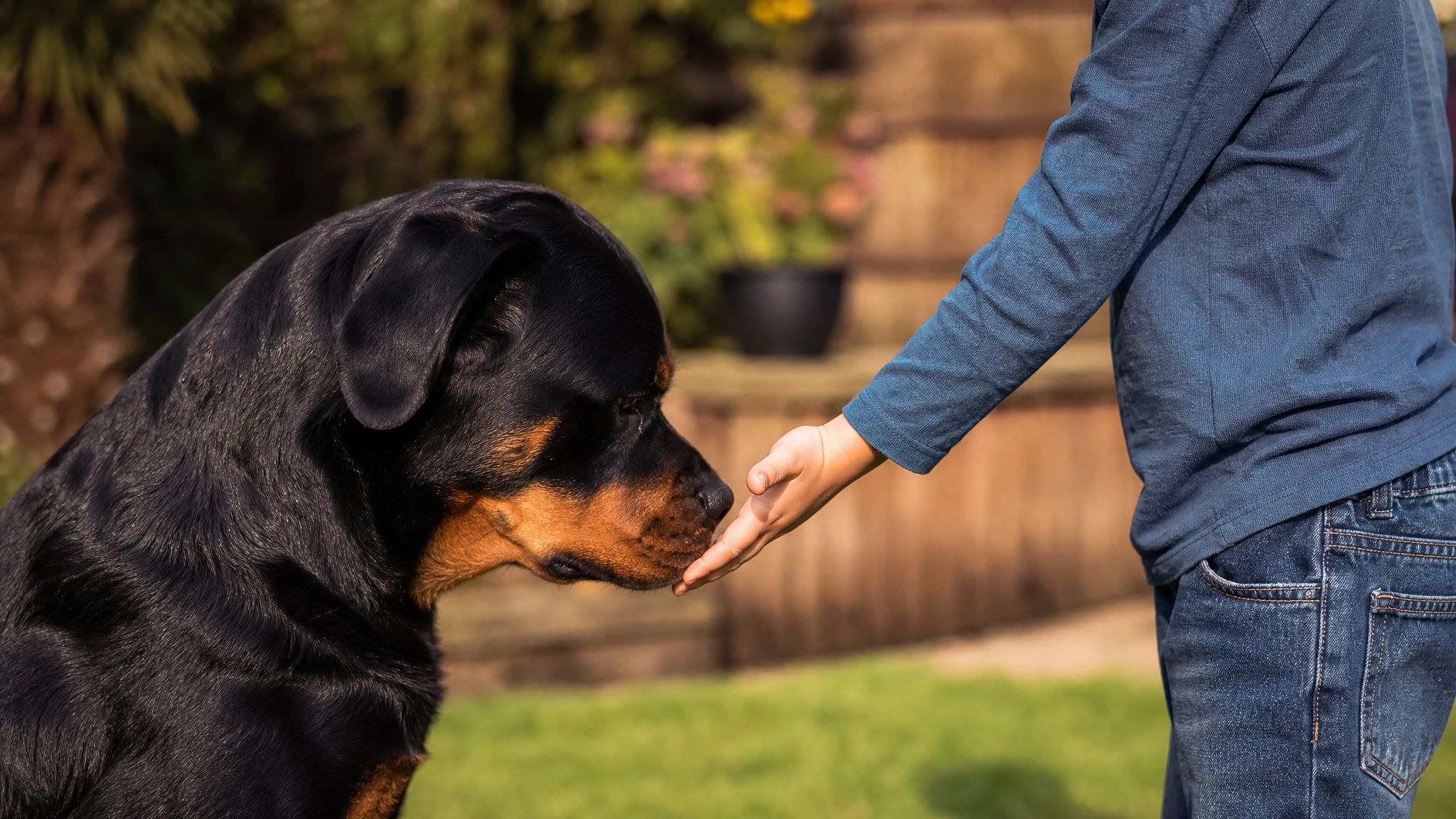
5. Introduce children with rules for the children and the dog
Rottweilers can be loving family dogs, and the AKC rates them 5 out of 5 for affection with family. But the AKC's 3 out of 5 for young children means supervision is part of the deal.
- Supervise every interaction. An adult stays within arm's reach and pays attention to the dog, not a phone.
- Teach kids the basics. Pet gently, do not hug or climb on the dog, and leave it alone while it eats or sleeps.
- Let children help with rewards. A child can toss a treat to a dog sitting politely. This builds good feelings on both sides.
- Give the dog an exit. A crate, pen or gated room lets your dog opt out before it gets overwhelmed.
- Stop jumping early. The ARC advises discouraging jumping on and grabbing at children while the puppy is small, since an adult may reach 100 pounds.
Skip rough play. The AKC notes that roughhousing may encourage aggression in the breed. Choose structured games like fetch, find-the-treat or practicing tricks.
6. Watch for herding and bumping behavior around kids
The ARC flags a trait tied to the breed's cattle-driving past: bumping and herding children or elderly family members. It can look harmless, but a bump from a large dog can knock a small child down.
If you see it, calmly redirect. Ask for a sit or send your dog to its mat, and reward it. Do not scold or punish. Give your dog a more suitable outlet, such as a puzzle toy or a training game. The ARC also notes the breed is not recommended for the elderly or physically infirm, because the dog can knock a person down.
7. Introduce other dogs carefully
The ARC lists dog-to-dog aggression and same-sex intolerance among the breed's known challenges. The AKC breed standard does not fault aggression toward other dogs in the ring. In other words, the breed's official description does not promise your dog will like every dog it meets. Plan for that.
Here is a safer way to approach it:
- Start with parallel walks. Walk with a calm, known dog at a distance where both dogs stay relaxed. Close the gap slowly over several outings.
- Pick the partner with care. A friendly dog of the opposite sex is often an easier first match, given the same-sex intolerance the ARC describes.
- Keep greetings short. Use loose leashes, call your dog away after a few seconds and reward the recall.
- Skip dog parks. Off-leash crowds are unpredictable, and the ARC says a Rottweiler must never run loose.
- Use class for dog practice. A well-run puppy or obedience class gives you controlled exposure with a trainer present.
If you already have a dog at home, the ARC says puppies adapt more easily to resident dogs and cats than young adults or mature dogs do. Introduce them on neutral ground, then supervise closely and give each dog separate space and food.
8. Keep going for life
The ARC says training must start early and continue for life because of the adult dog's size and strength. Keep up classes, outings and calm practice with new people. Many owners find that sports and activities help, and the ARC supports activities like obedience, rally, tracking, agility and therapy work. These give your dog structure around new people and places.
Tips for Better Results
- Reward calm, not excitement. Treat the quiet moments, not just the happy bounces.
- Exercise first. The AKC rates the breed 5 out of 5 for mental stimulation needs and lists daily exercise as a need. A tired, mentally busy dog finds it easier to settle around visitors.
- Be consistent. The AKC describes the right approach to discipline as consistent, fair and firm, without being rough. Everyone in the house should use the same cues and rules.
- Include your dog in family life. The AKC calls Rottweilers "people dogs" that do poorly when isolated from humans.
- Keep sessions short. Several brief sessions beat one long one.
Common Mistakes to Avoid
- Forcing greetings. Pushing a nervous dog toward a stranger or child can teach it that new people are a threat.
- Using harsh corrections. The ARC advises avoiding very rough trainers, and AVSAB guidance supports reward-based methods. Rough handling can damage trust and make behavior harder to manage.
- Roughhousing. The AKC warns it may encourage aggression.
- Leaving kids and dog alone together. Even a gentle dog needs an adult watching.
- Assuming a friendly puppy will stay that way. Behavior can change with maturity, so keep training.
- Waiting to address bullying or bluffing. The ARC says a strong territorial instinct may lead a Rottweiler to try to bully or bluff owners, and that this should be addressed while the dog is a young puppy.
- Skipping help when something worries you. If your dog growls, lunges or stiffens around people or dogs, work with a qualified positive-reinforcement trainer. If behavior changes suddenly, ask your veterinarian to check for pain or illness first.
What to Expect
With regular, patient practice, many Rottweilers become calmer and more predictable around visitors, children and other dogs. Progress varies by dog. Some puppies settle quickly, and others need more time and distance. Your own consistency and the dog's temperament both play a role.
Do not expect every Rottweiler to be a social butterfly. The AKC's ratings of 3 out of 5 for openness to strangers, children and other dogs suggest a dog who does best with careful management. A realistic goal is a dog that is polite, controlled and safe, even if it is not the first to make friends.
Whatever your dog's personality, keep supervision, secure fencing and a leash as permanent parts of your routine. The ARC recommends a yard, ideally with a six-foot fence, and says it is essential for a puppy or young dog.