How to Train a Rottweiler: The Complete Guide
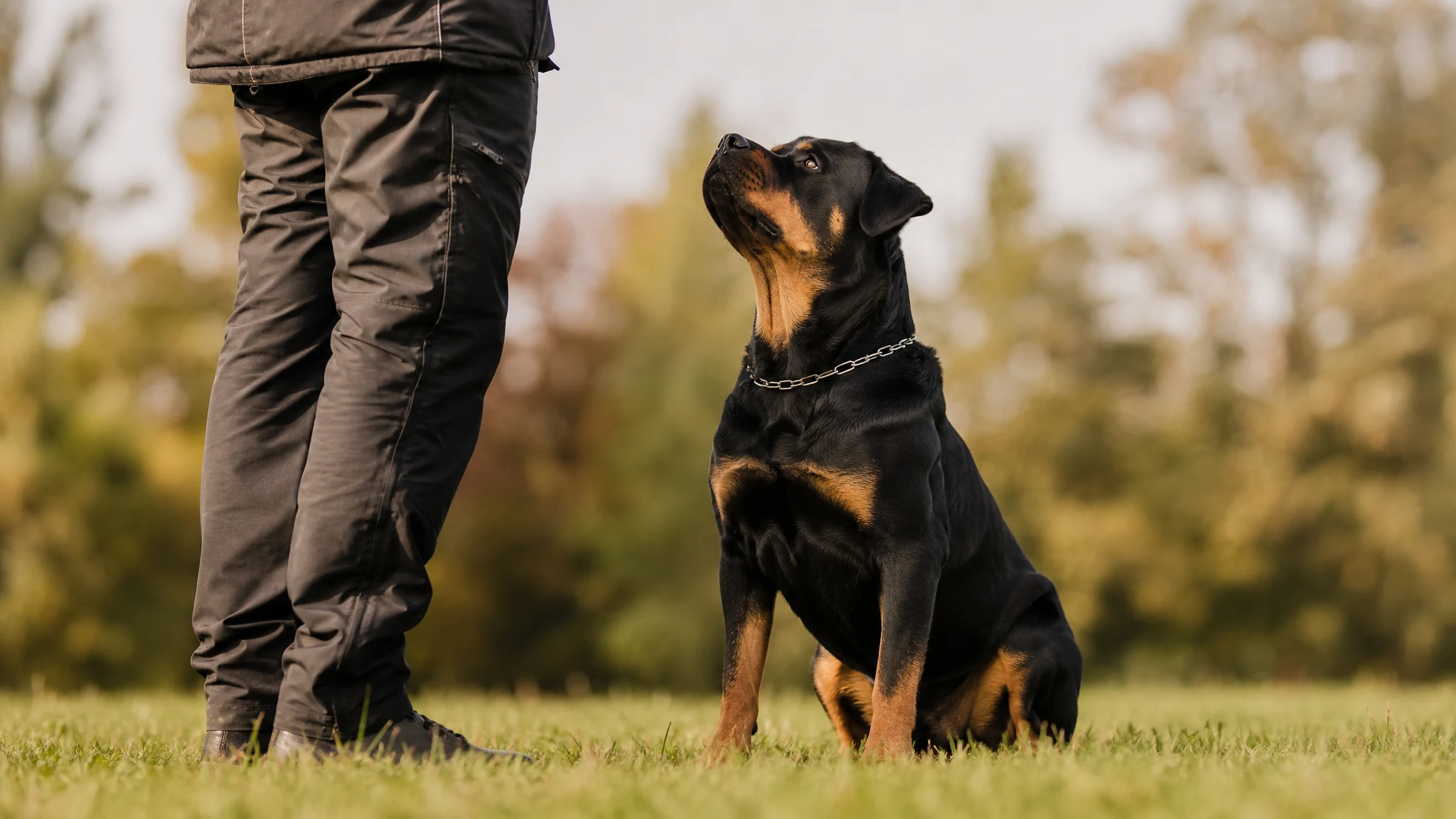
General training information. Every dog is an individual; for health or behavior concerns, see your veterinarian.
Rottweiler training works best when you understand the dog first. This is a breed built for real work, with a calm, watchful nature and a lot of size and strength. A well-trained Rottweiler is a steady, affectionate partner. An untrained one is a big dog making its own decisions.
This guide covers how to train a Rottweiler from the first week home through adulthood. It explains what the breed was made to do, which methods suit it, how the stages unfold, and which problems to plan for. Every breed fact here comes from the American Kennel Club (AKC), the American Rottweiler Club (ARC) or the Orthopedic Foundation for Animals (OFA). Individual dogs vary, so treat these as starting points.
Key takeaways
- The AKC rates the Rottweiler 5 of 5 for trainability and 5 of 5 for mental stimulation needs. This is a dog that wants a job.
- The ARC says training must start early and continue for life because of the adult dog's size and strength.
- Use positive reinforcement. The ARC advises avoiding very rough trainers, and its trainer guide lists prong, choke and electronic collars as tools you do not want to see.
- Socialization, a fenced yard and a leash are not optional. The ARC says Rottweilers must never run loose.
- Plan for territorial instincts, dog-to-dog issues and bumping or herding of family members.
- Take any health or pain question to your veterinarian before you blame behavior.
In this guide
- What the Rottweiler Was Bred to Do
- Temperament and Traits to Train Around
- Methods That Work for This Breed
- Training Stages: Puppy to Adult
- Exercise and Mental Work
- Challenges to Plan For
- Jobs, Sports and Health Notes
- Sources
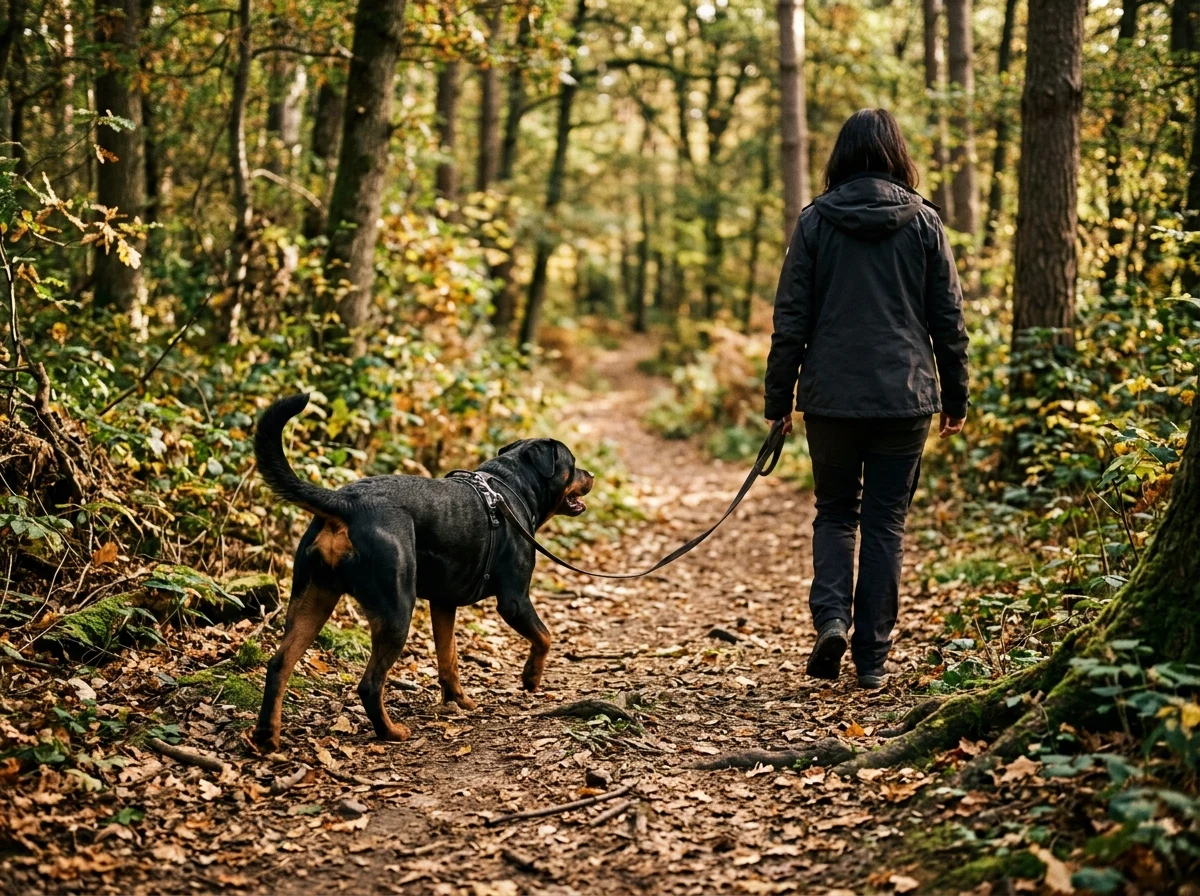
What the Rottweiler Was Bred to Do
Every breed training plan should begin with the job. The AKC says the Rottweiler comes from Germany, from the town of Rottweil, and descends from Roman drover dogs. These dogs drove and guarded herds of cattle. Later they moved herds to market and protected the drovers.
The American Rottweiler Club adds detail in its history of the breed. Butchers and cattle traders in Rottweil used the dogs to drive livestock, guard money pouches, and protect homes and businesses. That is why you hear the old name, the Butcher's Dog of Rottweil.
The AKC also notes that railroads ended cattle droving in the 1800s. The breed then found new work as police dogs, personal protectors, early guide dogs and search and rescue dogs. The AKC recognized the Rottweiler in 1931 and places it in the Working Group.
What that history means at home
A dog bred to work near people, make decisions around livestock and guard property will bring some of that into your living room. You may see it as watchfulness at the door, interest in what the family is doing, or a habit of gently steering people around.
That does not make every Rottweiler the same. The ARC describes a range, from natural clown to reserved one-person dog. But the working background explains why this breed does best with a purpose, clear routines and an owner who trains on purpose.
Temperament and Traits to Train Around
The AKC sums up the breed as a loyal, loving, confident guardian. The AKC breed standard describes a calm, confident, courageous dog with a self-assured aloofness and an inherent desire to protect home and family. It also says the breed responds quietly, with a wait-and-see attitude, and has a strong willingness to work.
The ARC calls them calm and alert companions, and says they need a calm, stable and firm leader. Here is how the AKC scores several traits on its 1 to 5 scales.
| Trait (AKC scale) | Rottweiler score | What it means for training |
|---|---|---|
| Trainability | 5 of 5 (Eager to Please) | Quick to learn when training is clear and fair |
| Mental stimulation needs | 5 of 5 (Needs a Job or Activity) | Bored dogs invent their own work |
| Watchdog and protective nature | 5 of 5 (Vigilant) | Teach what to do when someone arrives |
| Affectionate with family | 5 of 5 (Lovey-Dovey) | Praise and closeness are strong rewards |
| Playfulness | 4 of 5 | Games can be built into training |
| Adaptability | 4 of 5 | Handles new routines with practice |
| Energy level | 3 of 5 (Moderate) | Daily exercise, not constant motion |
| Openness to strangers | 3 of 5 (Ambivalent) | Needs careful, positive exposure to new people |
| Good with young children | 3 of 5 (With Supervision) | Supervise and teach manners early |
| Good with other dogs | 3 of 5 (With Supervision) | Introduce and manage with care |
| Barking level | 1 of 5 (Only To Alert) | Usually quiet, but alerts when something is up |
Read that table as a picture of the breed on average. It is not a promise about your dog. Still, it shows the pattern: smart, eager, devoted and watchful. That combination rewards good training and exposes weak training quickly.
The AKC also calls Rottweilers "people dogs" that do poorly when isolated from humans. Training happens best as part of daily family life, not as a chore squeezed in after the dog has spent a day alone in a yard.
Methods That Work for This Breed
Both the AKC and the ARC point toward fair, patient training. The AKC says discipline should be consistent, fair and firm, without being rough. It also notes that while Rottweilers are intelligent and want to please, some may be stubborn. The ARC says to avoid very rough trainers, and that sensitive and positive methods, time and patience matter more than physical mastery.
That fits the American Veterinary Society of Animal Behavior (AVSAB) position that reward-based training is the humane approach. So here is the plan: reward what you want, manage the setting so the dog can succeed, and stay calm.
Rewards that fit a Rottweiler
- Food: Small, soft treats work for most dogs. Count them as part of the daily meal amount and ask your vet about portions.
- Praise and touch: With a breed the AKC scores 5 of 5 for affection toward family, your voice and attention carry real weight.
- Play: A short game of tug or fetch after a good repetition keeps sessions fun. Keep the play controlled, a point we return to below.
- Access: Going through the door, getting the leash on, or being released to sniff are rewards too.
What to leave out
Do not use shock collars, prong collars, choke collars, alpha rolls, scruffing or any dominance-based method. The ARC's guide to finding a trainer lists prong, choke and electronic collars among the tools you do not want to see in a class. These methods can create fear and conflict, and a large, strong dog that learns to fear its handler is a bigger problem than the one you started with.
"Firm" in the AKC and ARC wording means consistent. It means the same rule every day, delivered calmly. It does not mean physical force.
Be the calm, stable leader
The ARC says the breed needs a calm, stable and firm leader. In practice that looks like predictable routines, clear cues, rewards for good choices and quiet interruption of bad ones. You are not winning a contest. You are giving a smart dog a reliable framework.
Finding a class
The ARC says obedience training is a must. It recommends a group class with an experienced trainer who uses positive reinforcement, and Puppy Kindergarten for early socialization. Visit a class without your dog first. Watch how the trainer handles nervous or pushy dogs, and walk away from any program that relies on the tools listed above. The ARC's guide to finding a good dog trainer lists what to look for and what to avoid, so read it before you sign up.
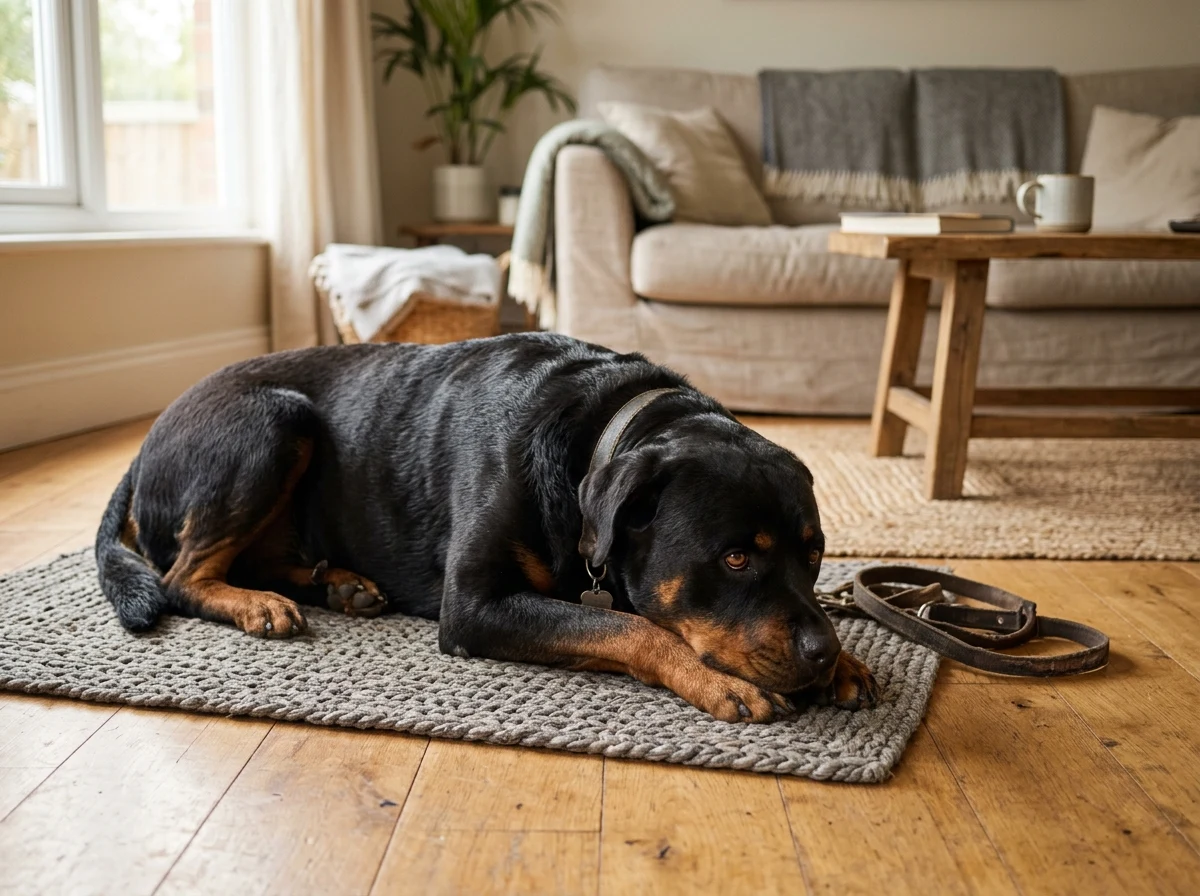
Training Stages: Puppy to Adult
The AKC advice is to train early, covering leadership, puppy socialization, basic classes and living in the home. The ARC adds that training must continue for life. Think of it as a ladder, where each stage builds on the one before. Ages differ from dog to dog, so judge by skill and maturity, not the calendar alone.
Stage 1: The new puppy at home
Your first goals are simple. Teach the house rules, build a bond and start gentle handling. The ARC describes well-adjusted puppies as playful, inquisitive and trusting, and says they accept gentle handling. Practice touching paws, ears, mouth and collar area while giving treats, so grooming and vet visits stay easy later.
Start the basics right away, in very short sessions:
- Name response and eye contact
- Sit, down and come, rewarded every time at first
- Crate or settle-on-a-mat training, so the dog learns to relax
- Toilet routine with frequent trips outside and quick rewards
- Taking food and toys politely from your hand
The ARC advises discouraging a small puppy from jumping on and grabbing at children, since an adult may reach 100 pounds. Start that now. Teach a four-paws-on-the-floor greeting by rewarding it and turning away from jumping.
Stage 2: Socialization
Socialization is not just meeting people. It is learning that ordinary things are safe. Aim for calm, positive experiences with different people, surfaces, sounds, vehicles and places. Pair each one with treats and let the puppy set the pace. Ask your veterinarian which places are safe while vaccinations are in progress.
This matters more for a breed with protective instincts. The AKC says territorial instincts need early training and socialization. The AKC scores openness to strangers at 3 of 5, which means many Rottweilers are not automatically friendly to everyone. Build neutral confidence early, so the dog learns that visitors are normal and your cue is what counts.
Sign up for a Puppy Kindergarten class if you can. The ARC recommends it for early socialization. If you already have dogs or cats, note the ARC observation that puppies adapt more easily to resident dogs and cats than young adults or mature dogs do.
Stage 3: Manners and basic obedience
Once the puppy has the basics, make them reliable. Practice in more places, with more distractions, for slightly longer stretches. Core skills for this stage:
- Loose-leash walking: Start in a quiet area. Reward the dog for staying beside you and stop moving when the leash tightens. This matters for a dog that will be strong.
- Recall: Practice on a long line in a secure area. Reward generously. Never punish a dog for coming to you.
- Stay and wait: Use it at doors, car exits and feeding time.
- Leave it and drop it: Trade for a treat so the dog learns that giving up an item pays off.
- Place: Send the dog to a mat when visitors arrive.
Keep going with group classes. The ARC says obedience is a must, and a class gives you practice around other dogs with a trainer watching.
Stage 4: Adolescence
Many owners find this the hardest stretch. The puppy is bigger, more confident and more likely to test what it learned. Expect some regression. Go back to higher-value rewards, shorter sessions and more management, such as a leash or house line when the dog is excitable.
The ARC notes that the protective instinct becomes apparent with maturity. That is a good reason to keep socialization going after the puppy stage, and to teach calm responses to doorbells, knocks and passersby before the instinct is fully developed.
It is also the age when the ARC's warning about bullying or bluffing matters. The club says a Rottweiler may try to "bully" or "bluff" its owners, and that this should be addressed while the dog is a young puppy. Calm, consistent boundaries with rewards for good choices are the answer, not a fight.
Stage 5: The adult dog
Adult training is maintenance and growth. Keep cues sharp, keep rewarding, and add new skills. The ARC says training must continue for life, and with a dog that can weigh close to or over 100 pounds, that is practical advice.
Weight depends on the source. The AKC gives 95 to 135 pounds for males and 80 to 100 pounds for females. The ARC's owner guidance gives 95 to 125 pounds for males and 75 to 95 pounds for females. The AKC lists height at 24 to 27 inches for males and 22 to 25 inches for females. Either way, this is a powerful dog, and manners at the door and on the leash are a safety issue.
Adult dogs also benefit from new challenges. Move on to advanced obedience, scent work, tracking or another activity (more in the jobs section below). A trained adult with a job is generally easier to live with than one coasting on early lessons.
Exercise and Mental Work
The AKC lists the Rottweiler's energy level at 3 of 5, which is moderate, and its mental stimulation needs at 5 of 5. The ARC says puppies and adults need socialization, exercise and mental challenges, or they may become destructive. So the formula is a daily outing plus daily brain work.
Physical exercise
The AKC says the breed needs daily exercise and enjoys swimming, walking and trotting with people. Regular leashed walks, controlled fetch, swimming in safe settings and time with the family cover most of it. Ask your veterinarian how much and what kind is right for a growing puppy, since I have not found breed-specific growth guidance from the breed clubs to share here.
The ARC recommends a yard, ideally with a six-foot fence, and says it is essential for a puppy or young dog. A fence does not replace time with you. The AKC says these dogs do poorly when isolated from people, so a yard is for supervised play and toilet breaks, not for leaving the dog alone all day.
Mental work
This is where many owners under-deliver. A 5 of 5 on mental stimulation means the dog needs something to think about. Try:
- Short training sessions several times a day, even just five minutes
- Food puzzles and scatter feeding in the yard
- Nose work games, such as hiding treats around a room
- Learning new tricks and cues
- Carrying a light item on walks, if your dog enjoys it
- Carting, tracking or other formal activities
A tired dog is not always a trained dog, but a bored dog is often a destructive one. Plan the work before the problems start.
Play with rules
The AKC warns that roughhousing may encourage aggression. Choose structured games: fetch with a drop cue, tug with start and stop signals, and hide-and-seek. End play before the dog is overexcited, and stop any game that turns into mouthing or grabbing.
Heat
The ARC notes that Rottweilers are susceptible to heat stroke, citing the black coat and short muzzle. Exercise early or late on warm days, carry water, provide shade and never leave the dog in a parked car. If you see heavy distress in the heat, contact a veterinarian right away.
Challenges to Plan For
The Rottweiler is a breed to enjoy, but honest planning matters. The AKC and ARC both flag several challenges. Knowing them ahead of time is what lets you train around them.
Territorial and protective behavior
The AKC says territorial instincts need early training and socialization. The ARC says strangers must not enter the home or yard unannounced. Practical steps:
- Teach a reliable place cue for visitors, and reward the dog for staying put.
- Keep gates latched and tell delivery workers and guests how to approach.
- Practice greetings at a distance, with treats, so strangers predict good things.
- Do not encourage guarding behavior as a game.
Bullying, bluffing and testing
The ARC says the breed may try to bully or bluff owners and that this should be addressed while the dog is a young puppy. Do not wait. Set rules on day one, reward calm manners and stay consistent.
Bumping and herding people
The ARC lists bumping and herding children or elderly family members as a legacy of the cattle-herding past. It can be harmless in intent but hard on a small child or an unsteady adult. Teach the dog to settle on a mat while people move around, reward four paws on the floor, and supervise closely around children. The AKC rates the breed 3 of 5 for young children, which it defines as good with supervision.
The ARC also says the breed is not recommended for the elderly or physically infirm, since a Rottweiler can knock a person down. Consider that carefully before bringing a dog home.
Other dogs
The ARC lists dog-to-dog aggression and same-sex intolerance among the breed's issues. The AKC breed standard does not fault aggression toward other dogs in the ring, though shy dogs are excused. That tells you the breed standard leaves room for dogs that are not social, so do not assume yours will love the dog park.
What helps:
- Start puppy classes and controlled meetings early.
- Introduce dogs one at a time, on neutral ground, on leash.
- Reward calm looks at other dogs from a distance.
- Be honest about whether off-leash dog parks suit your dog.
If you see stiffness, hard staring or growling, increase distance and get help from a qualified trainer who uses positive methods or a veterinary behaviorist.
Never off leash and unsecured
The ARC says Rottweilers must never run loose. Use a leash in public, a secure fence at home and a long line for recall practice. This protects the dog, your neighbors and you.
Stubborn streaks
The AKC says some Rottweilers may be stubborn. Usually this means the reward is too low, the setting is too hard, or the cue was never clear. Make the task easier, pay better and keep sessions short. Calm persistence beats frustration.
When to get professional help
Call a qualified, reward-based trainer or a veterinary behaviorist if your dog shows fear, guarding, snapping or aggression toward people or dogs. Also see your veterinarian, since pain and illness can change behavior. I cannot diagnose a dog or suggest medications, so a vet visit is the right first step for any sudden change.
Jobs, Sports and Health Notes
Giving the dog a job
The AKC lists carting, herding, tracking and obedience for the breed. The ARC history page adds police and military work, search and rescue, service and therapy work, family protection, and protection sports. The AKC also mentions search and rescue work at Oklahoma City and the World Trade Center.
The ARC's Work and Play page lists supported activities including agility, barn hunt, carting, conformation, coursing ability, herding, obedience, rally, Sieger, therapy dog and tracking. For a first activity, many owners find obedience, rally, tracking or barn hunt approachable. Check with the ARC or a local club to see what is offered in your area, and confirm requirements with the organizer.
Health and training
Health affects training, from sore joints to eyesight. The ARC lists common health concerns including cancers, hip and elbow dysplasia, eye conditions such as cataracts, entropion and ectropion, epilepsy, subaortic stenosis and protein losing enteropathy. It also lists several DNA-testable neurologic and muscle conditions.
OFA's CHIC program for Rottweilers lists hip evaluation, elbow evaluation, an eye exam at 24 months or older, and a cardiac evaluation. A DNA test for JLPP is optional for CHIC, though the ARC requires at least one parent to be JLPP clear before breeding. The ARC health statement notes that club screens for hips, elbows, eyes and heart are done at 24 months or older. If you are choosing a puppy, ask the breeder for these results and check with the ARC.
The AKC cites research linking cancer and longevity to keeping dogs intact until at least six years. This is the AKC's summary of one research program, not settled guidance, so talk with your veterinarian about timing. The AKC lists the breed's life expectancy at 9 to 10 years, which is one more reason to enjoy the training years.
Putting it together
Here is a simple weekly outline you can adapt:
- Daily: two or three short training sessions, one walk or outing, one mental game.
- Weekly: a group class or a practice session in a new place.
- Ongoing: socialization with new people and places, always positive.
- Monthly: review which cues are slipping and which new skill to add.
No plan guarantees an outcome. But steady, kind, consistent rottweiler training tips down to this: start early, reward often, manage the environment and never stop. That is how to train a Rottweiler into the calm, confident companion the breed standard describes.
Sources
- AKC Rottweiler breed page
- AKC Official Standard of the Rottweiler
- American Rottweiler Club
- American Rottweiler Club, About the Rottweiler
- American Rottweiler Club, Owning a Rottweiler
- American Rottweiler Club, Rottweiler Breed Health
- American Rottweiler Club, History of the Rottweiler
- American Rottweiler Club, How to Find a Good Dog Trainer
- American Rottweiler Club, Work and Play
- OFA CHIC program: Rottweiler