Leash Training a Rottweiler: Pulling, Lunging and Loose-Leash Walking
General training information. Every dog is an individual; for health or behavior concerns, see your veterinarian.
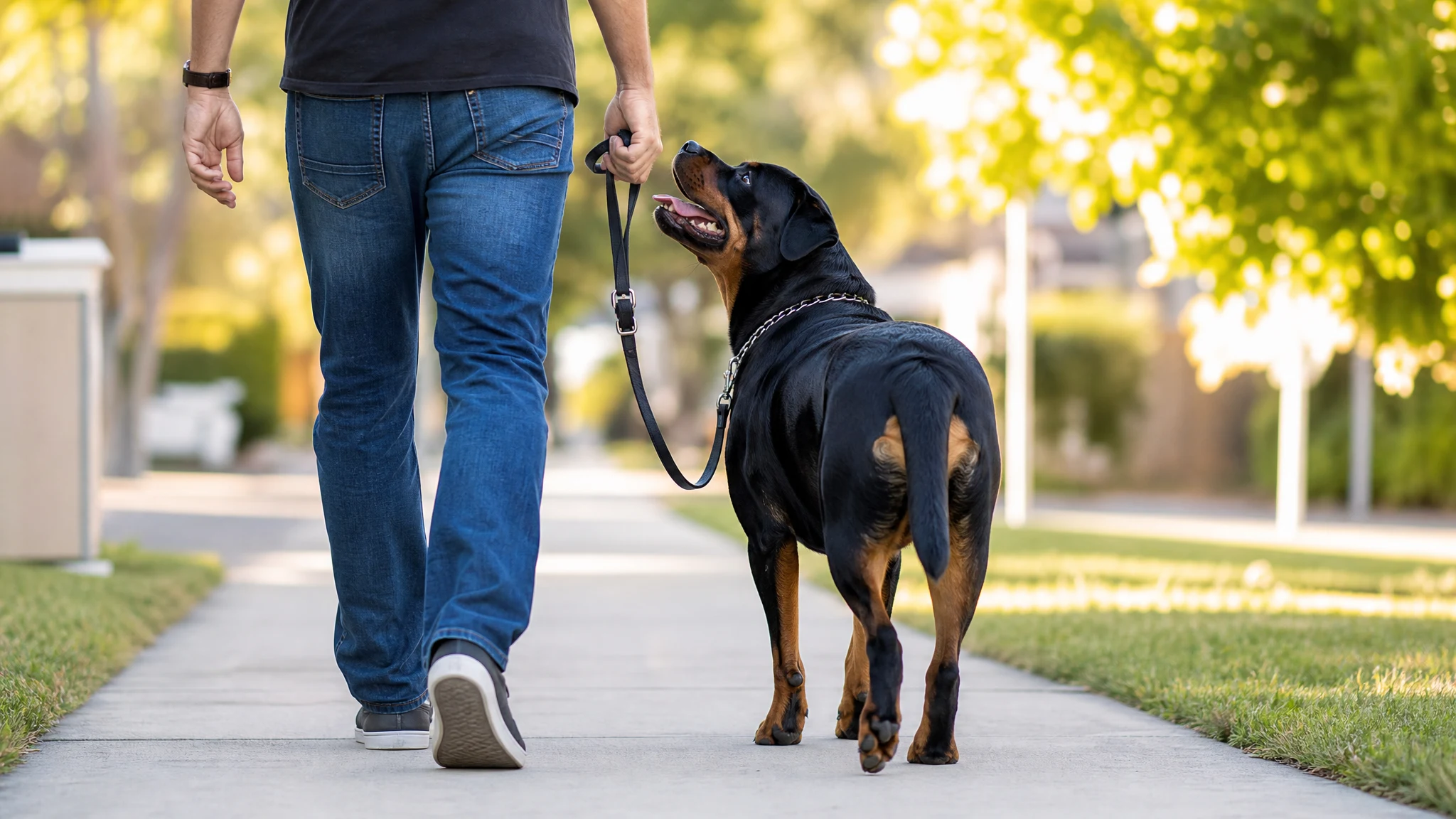
A Rottweiler on a tight leash is a lot of dog at the other end. The American Rottweiler Club lists adult males at 95 to 125 pounds and females at 75 to 95 pounds. The AKC lists 95 to 135 pounds for males and 80 to 100 pounds for females. Either way, a dog that drags you down the sidewalk is a safety problem, not just an annoyance.
This guide covers rottweiler leash training from the first day to the first busy street. You will find out why the breed pulls, what gear to use, how to teach loose-leash walking step by step, and how to handle lunging. For the wider picture, see our complete guide to training a Rottweiler.
Why Rottweilers Pull
Rottweiler pulling on leash is rarely stubbornness for its own sake. A few breed facts explain a lot.
- Working heritage. The AKC says the breed descends from Roman drover dogs that drove and guarded cattle herds. The American Rottweiler Club adds that butchers and cattle traders in Rottweil used them to drive livestock and protect property. A dog bred to move forward with purpose will often do exactly that on a walk.
- A need for a job. The AKC rates the breed 5 of 5 for mental stimulation needs, on a scale where 5 means it needs a job or activity. A walk with no task in it can leave a Rottweiler hunting for its own entertainment.
- Moderate energy, daily exercise. The AKC rates energy level 3 of 5 and says the breed needs daily exercise. A dog that gets too little may arrive at the leash with a lot to burn.
- Eager to learn. The AKC rates trainability 5 of 5 (eager to please). That works in your favor, because a Rottweiler can learn a loose leash quickly when the lessons are clear.
Individual dogs vary. Some Rotties plod, some surge. The steps below work either way, because they teach the dog that a slack leash is what makes the walk happen.
Why Lunging Is a Separate Problem
Pulling and lunging look similar from the handle end, but they have different causes. Pulling is usually about getting somewhere. Lunging is usually a reaction to something, such as another dog, a stranger or a bicycle.
The AKC rates the breed 5 of 5 for watchdog and protective nature, and 3 of 5 for openness to strangers. The American Rottweiler Club says Rottweilers have a strong territorial instinct. It also lists dog-to-dog aggression and same-sex intolerance among the breed's challenges. The AKC says territorial instincts call for early training and socialization.
None of that means your dog will lunge. It does mean you should plan for it and start socialization early, rather than waiting for the first scene on a walk.
Materials You Need
- A flat collar that fits snugly enough that it will not slip over the head, with room for two fingers underneath. It holds ID tags and gives you a place to clip on.
- A front-clip harness (optional but useful). The leash attaches at the chest, so a forward lunge tends to turn the dog toward you instead of letting it power ahead. Make sure it fits well and does not restrict the shoulders.
- A standard 4 to 6 foot leash in a strong, comfortable material. Skip retractable leashes. They teach a dog that pulling extends the walk, and they give you little control at the moment you need it.
- Small, soft, high-value treats that you can deliver fast. Pea-sized pieces keep the walk moving. Count them toward the day's food.
- A treat pouch so rewards are always at your hip.
- A quiet starting place, such as a fenced yard or a hallway. The American Rottweiler Club recommends a yard, ideally with a six-foot fence, and calls it essential for a puppy or young dog.
Gear to Leave in the Store
Do not use prong, choke or shock collars. The American Rottweiler Club's guide to finding a trainer lists prong, choke and electronic collars among the tools you do not want to see in a class. The club also advises avoiding very rough trainers and says sensitive, positive methods, time and patience matter more than physical mastery. Both the AKC and the club describe the right discipline as consistent, fair and firm, without being rough.
How to Leash Train a Rottweiler: Step by Step
Here is how to leash train a Rottweiler in a way that builds on the breed's willingness to work. Keep sessions short, five to ten minutes, and end on a success.
- Get comfortable with the gear. Let your dog sniff the collar, harness and leash. Pair each with a treat. Clip the leash on indoors and let the dog drag it for a minute or two while you feed treats. The goal is a dog that sees the leash and thinks something good is coming.
- Teach attention first. Say your dog's name or a marker word such as "yes," then treat when the dog looks at you. Repeat until the dog checks in with you on its own. A dog that looks to you is a dog you can steer.
- Pick a side and a spot. Choose the side you want the dog on and feed every treat there, right beside your leg. Many trainers use the left side, but either works. Consistency matters more than which side you pick.
- Reward position in the yard. Take one step with the dog beside you. If the leash is slack, mark and treat at your leg. Add a second step, then three. Build up slowly. Rewards come often at first, then spread out as the dog gets the idea.
- Add a cue for the walk. When your dog is walking nicely with you, add a cue such as "with me." Say it just before you move off, so the cue means "stay near and the leash stays loose."
- Stop when the leash tightens. This is the core of loose-leash walking. The moment the leash goes tight, stop moving and stand still like a tree. Do not yank, jerk or shout. When your dog looks back or steps toward you and the leash loosens, mark, treat and walk on. The dog learns that pulling stops the walk and slack restarts it.
- Change direction when needed. If standing still is not working, turn and walk the other way, calmly. Reward the dog for catching up. This teaches the dog to keep an eye on where you are headed.
- Take it to the driveway, then the street. Add distractions one level at a time. Move from yard to driveway to a quiet street to a busier one. If the dog starts pulling hard, you moved up too fast. Go back a level and rebuild.
- Thin the treats, keep the rewards. Over weeks, reward every few steps rather than every step. Add rewards that are not food, such as permission to sniff a favorite spot. Real-life rewards fit in well here, because a Rottweiler that needs a job on a walk often enjoys earning them.
Loose-Leash Games to Practice
Games keep the lessons fun and give a Rottweiler the mental work the AKC says it needs.
- Follow me. Walk in an irregular path with turns and circles in the yard. Reward the dog every time it stays beside you. It teaches the dog to watch you and not the horizon.
- Red light, green light. Walk, stop suddenly, and reward the dog for stopping with you. Then walk on again. It builds focus and quick responses.
- Sniff break as a reward. After 20 or 30 steps of loose leash, say a release word such as "go sniff" and let the dog explore. Sniffing is satisfying, and it turns the thing your dog wants into the prize for walking well.
- Treat scatter reset. If your dog is overexcited, toss a few treats on the ground and say "find it." This slows the dog down and gets its nose working.
Handling Lunging at Triggers
Lunging needs a plan before the trigger appears. The aim is to keep your dog under its threshold, which is the distance at which it can still notice a trigger and take a treat.
- Spot the trigger early. Watch for a stiff body, a fixed stare or a closed mouth. These are signs that your dog has noticed something.
- Create distance. Cross the street, step behind a parked car, or turn around. Distance is the most useful tool you have.
- Feed while the trigger is in view. Give a steady stream of small treats as long as the trigger is visible and your dog stays calm. When the trigger leaves, the treats stop. The dog learns that the sight of a trigger predicts good things.
- Practice with helpers. Ask a friend with a calm, well-behaved dog to stand at a distance while you reward your dog for looking at them and then back at you.
- Do not punish the reaction. Yelling, leash jerks and corrections can make a dog link the trigger with something unpleasant. That can make lunging worse.
The American Rottweiler Club says Rottweilers should never run loose and that strangers must not enter the home or yard unannounced. On walks, that means a secure leash, a secure grip and no off-leash time in unfenced areas.
If your dog is lunging with a hard stare, growling or snapping, bring in help. The American Rottweiler Club recommends a group class with an experienced trainer who uses positive reinforcement, and a Puppy Kindergarten class for socialization. Ask any trainer what tools and methods they use before you sign up.
Tips for Better Walks
- Exercise first. The AKC says the breed enjoys swimming, walking and trotting with people. A short play session before a training walk can take the edge off.
- Start puppy habits early. The American Rottweiler Club notes that an adult may reach 100 pounds and advises discouraging jumping on and grabbing at children while the dog is small. The same logic applies to leash manners. A habit that is cute at 15 pounds is a problem at 100.
- Keep your own body calm. A tight leash and tense arm can signal worry down the line. Keep your hand relaxed and the leash in a soft J shape.
- Mind the heat. The American Rottweiler Club notes susceptibility to heat stroke in this breed, citing the black coat and short muzzle. Walk in the cool parts of the day in warm weather and carry water. Ask your veterinarian about any concerns.
- Keep training for life. The American Rottweiler Club says training must start early and continue for life because of the adult size and strength of the breed.
Common Mistakes to Avoid
- Letting the dog pull sometimes. If pulling gets your dog to the park on Monday, it will try again on Tuesday. Everyone who walks the dog needs to follow the same rule.
- Training in hard places first. Teach the skill where it is easy, then build up.
- Using the leash to correct. Leash pops and yanks do not teach what to do. They only say what not to do, and they can strain the neck.
- Rough play before walks. The AKC notes that roughhousing may encourage aggression in the breed. Keep pre-walk play calm and structured.
- Skipping socialization. The AKC and the American Rottweiler Club both stress early socialization. A dog that has met many calm people and dogs from a young age is better placed to stay relaxed on a walk.
- Expecting speed. Rushing leads to frustration for both of you. Short, steady sessions work better.
What to Expect
Most owners who practice daily and stay consistent see the leash loosen over several weeks, and many dogs show a clear difference in a quiet setting before they manage a busy one. Results depend on the dog's age, history, the amount of practice and how many distractions are around. Adolescent dogs may backslide when they are excited. That is common, and it does not mean the training has failed.
Lunging usually takes longer than pulling and may improve in small steps. Some dogs do well with steady practice. Others need a trainer to watch them and build a plan. Neither outcome is a sign you did something wrong.
If your dog suddenly pulls more, lunges more or seems uncomfortable on walks, check with your veterinarian before assuming it is a training problem. Pain and other health issues can change behavior, and only a veterinarian can sort that out.