Crate Training a Rottweiler and Preventing Separation Anxiety
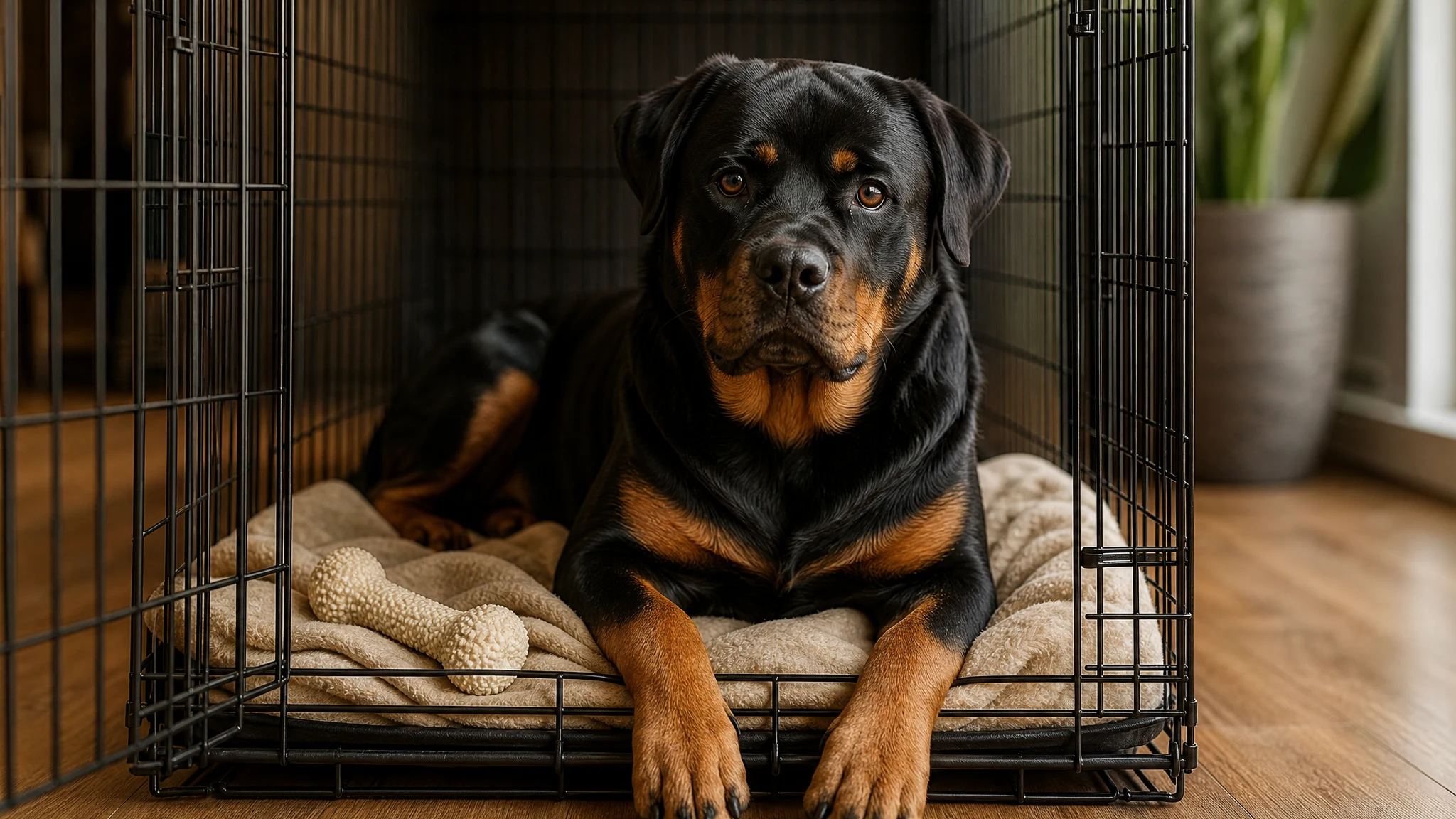
General training information. Every dog is an individual; for health or behavior concerns, see your veterinarian.
A Rottweiler wants to be where you are. The American Kennel Club (AKC) describes the breed as one of the "people dogs" that do poorly when isolated from humans, and rates the breed 5 out of 5 for being affectionate with family. That loyalty is a big part of the appeal. It also means alone time has to be taught on purpose.
This guide walks through Rottweiler crate training in small steps, then shows how to use the crate and short absences to head off Rottweiler separation anxiety. It covers crate size, introducing the crate, building alone time, signs of distress and when to call your veterinarian.
Why the crate matters for this breed
The AKC says Rottweilers do best when training starts early and when they live inside the home with the family. The American Rottweiler Club (ARC) adds that training must start early and continue for life because of the adult dog's size and strength.
A crate gives a young dog a safe, boring, predictable place to settle. Used well, it helps with house training, keeps a curious puppy out of trouble and teaches your dog that quiet time is normal. It does not replace exercise, company or training. For the wider picture, see our complete guide to training a Rottweiler.
A crate also is not a place to park a dog for long stretches. The ARC says puppies and adults need socialization, exercise and mental challenges, or they may become destructive. A dog that is crated too much and exercised too little is set up to struggle.
Materials you will need
- A sturdy crate sized for your dog (see the next section).
- A crate divider if you are starting with a puppy, so one crate can grow with the dog.
- Washable bedding that your dog will not shred. Remove it if your puppy chews it.
- Safe chew items and food puzzles that suit your dog's size and chewing style.
- Small, soft treats your dog loves, cut to pea size.
- A baby gate or exercise pen for practicing short separations in a safe space.
- A flat buckle collar or no collar in the crate. Loose gear can snag on crate bars.
- A daily schedule for meals, potty trips, exercise and rest.
Choosing the right crate size for a Rottweiler
Rottweilers are big dogs, and they get there fast. According to the AKC, males stand 24 to 27 inches and females 22 to 25 inches. The AKC lists weight as 95 to 135 pounds for males and 80 to 100 pounds for females. The ARC gives slightly lower ranges in its owner guidance: 95 to 125 pounds for males and 75 to 95 pounds for females.
Those numbers are your starting point. Individual dogs vary, so measure your own dog and compare the result to the crate maker's sizing chart. Check the brand's own guidance for dimensions and weight limits.
Two practical rules help:
- The crate should be large enough for your dog to stand up, turn around and lie down comfortably. Bigger is not better for house training, because a dog with too much room may use one end as a bathroom.
- For a puppy, buy a crate sized for the adult dog and block off the extra space with a divider. You will not need to replace it as your puppy grows.
Choose strong construction. An adult Rottweiler is powerful, and a flimsy crate can bend or fail. A heavy-duty wire or metal crate with secure latches is a common choice, but check the maker's weight guidance.
Placement matters too. The ARC notes that Rottweilers can be susceptible to heat stroke because of the black coat and short muzzle. Keep the crate out of direct sun and away from heaters, and make sure air can move around it.
Step-by-step: crate training a Rottweiler
Go at your dog's pace. If your dog backs off at any step, go back to the last step that went well. All training here is reward-based, in line with the American Veterinary Society of Animal Behavior (AVSAB). The crate is never a punishment.
Step 1: Set up a comfortable spot
Place the crate in a room where the family spends time, such as the living room or kitchen. A Rottweiler shut away from everyone can feel isolated. Add bedding and leave the door tied open so it cannot swing shut and startle your dog.
Step 2: Make the crate a good place
Toss a few treats near the door, then just inside, then at the back. Let your dog walk in, eat and leave as often as they like. Do not push or lift your dog in. Repeat over several short sessions until your dog walks in eagerly.
Step 3: Feed meals in the crate
Put your dog's food bowl inside. At first, set it near the entrance. Over several meals, move it toward the back. Once your dog is comfortable, close the door while they eat and open it as soon as the bowl is empty. This builds a simple link: the crate means good things happen.
Step 4: Add a cue
When your dog walks in on their own, say a short word such as "bed" and reward. Soon you can say the word first, point to the crate and reward your dog for going in. Keep your voice calm and upbeat.
Step 5: Close the door for short periods
Ask for the cue, close the door and feed a few treats through the bars. Sit next to the crate, then open the door before your dog gets restless. Gradually stretch the time you keep the door shut. Give a chew item to occupy your dog while you stay nearby.
Step 6: Move around the room
With your dog settled and chewing, stand up, walk a few steps and come back. Then go to the other side of the room. Build until you can do small chores in sight of the crate without your dog fussing. Return and reward before your dog gets upset, not after.
Step 7: Practice with you out of sight
Step out of the room for a few seconds, then return and calmly reward. Slowly lengthen the time. Mix in very short absences with longer ones so your dog cannot predict the pattern. Keep arrivals and departures low-key.
Step 8: Use the crate through the day
Once your dog is relaxed in the crate, use it for naps, for quiet time while you eat dinner and overnight if you choose. A tired dog settles more easily, so pair crate time with exercise. The AKC says Rottweilers need daily exercise and enjoy swimming, walking and trotting with people.
Preventing separation anxiety in a Rottweiler
Crate training and preventing Rottweiler separation anxiety go together, but they are not the same thing. A dog can love a crate and still struggle when the family leaves. The goal is to teach your dog that being alone is safe and that you always come back.
Start early. The ARC advises addressing a puppy's behavior early, and puppies are often easier to shape than adult dogs. If you have an adult or a rescue, the same steps apply, but go more slowly.
Build alone time in small steps
Begin with absences so short your dog does not have time to worry. Go to another room, close a gate, then return. Increase the time in small steps over days and weeks. If your dog starts to whine, pace or pant, you moved too fast. Shorten the next session.
Do not make departures a big event
A long goodbye and an excited hello teach your dog that something dramatic is happening. Instead, offer a chew, walk out calmly and return when your dog is quiet. Ignore frantic greetings for a minute, then say hello gently.
Meet physical and mental needs first
The AKC rates the breed 5 out of 5 for mental stimulation needs, which it describes as needing a job or activity. Before a planned absence, give a walk, a short training session or a food puzzle. The ARC lists many ways to channel that drive, including obedience, tracking, carting, herding, rally and agility.
Keep a predictable routine
Regular times for meals, exercise, potty trips and rest help dogs feel secure. Avoid sudden jumps from being with your dog all day to being gone all day. If your schedule is about to change, practice the new routine ahead of time.
Keep the dog safe and contained
The ARC says Rottweilers must never run loose and that strangers must not enter the home or yard unannounced. A secure crate or room, plus a fenced yard, keeps your dog safe while you are out. The ARC recommends a yard, ideally with a six-foot fence, and calls it essential for a puppy or young dog.
Signs of separation distress
Not every dog that cries in the crate has separation anxiety. Some are just bored, too full of energy or still learning. But these signs, especially if they show up when you leave or soon after, deserve attention:
- Barking, howling or whining that does not settle after the first few minutes
- Drooling, heavy panting or pacing in the crate or room
- Trying to escape the crate, chewing the door or scratching at exits
- House soiling in a dog that is otherwise reliable
- Refusing food or treats when left alone
- Following you from room to room and being unable to relax when you are home
One caution: the AKC rates the breed at 1 out of 5 for barking, where 1 means barking only to alert. A Rottweiler that barks or howls for long periods when left is doing something unusual for the breed, so pay attention to it.
Tips and common mistakes
- Using the crate as punishment. Your dog should want to go in. Never send a dog to the crate while angry.
- Going too fast. Most setbacks come from asking for long stretches too soon. Back up a step and rebuild.
- Letting a dog out while barking. It teaches that noise opens the door. Wait for a brief pause, then open it.
- Crating too long. A crate is not a substitute for exercise, company or toilet breaks. Ask your veterinarian how long your dog can wait.
- Skipping socialization. The ARC recommends a puppy kindergarten class for socialization and a group class with an experienced trainer using positive reinforcement.
- Rough methods. The ARC says to avoid very rough trainers. Both the AKC and ARC say discipline should be consistent and fair, not rough. Reward calm behavior and manage the environment instead.
- Rowdy play before crate time. The AKC notes that roughhousing may encourage aggression. Keep pre-crate play calm.
- Unsafe items in the crate. Remove anything your dog can shred or swallow.
When to see a veterinarian
Talk to your veterinarian if your dog shows intense distress, hurts themselves trying to escape, stops eating, or soils the house suddenly after being reliable. Medical problems can look like behavior problems, and only a veterinarian can sort that out. Do not give medications or supplements on your own.
If your veterinarian rules out a medical cause and the signs continue, ask for a referral to a qualified behavior professional who uses reward-based methods. The ARC's guide to finding a good dog trainer is a useful place to start when judging a class or trainer.
What to expect
Every dog learns at a different speed, and no method works for every dog. With steady practice, many Rottweilers come to treat the crate as a calm resting spot within a few weeks. Short absences often become easier as your dog gains confidence, though setbacks after changes in routine, a move or a stressful event are common.
Keep practicing and stay patient. The ARC says time and patience matter more than physical mastery with this breed. Stay consistent through puppyhood and into adulthood, because the AKC and ARC both stress that training continues for life.